[Artist Interview]
Resonating Emotion Beyond Technology in the Age of AI:
Artist KimDaejin
by LED.ART EDITORIAL
Have you ever encountered the deep emotions seeping through the heavy spread of ink and the restless surge of waves? Daejin Kim (daejin.creates), an artist with a robust 25-year foundation spanning editorial design, rail vehicle identity systems like KTX, and large-scale stage visuals, has recently taken up AI as his new artistic brush. In translating the intangible imagery of his mind onto and beyond the screen, his work weaves traditional Korean aesthetics—such as ink flow and crashing waves—with conflicting inner states: stillness and anxiety, restraint and liberation. More than fleeting technical novelty, he aims to leave behind images that linger deeply in the viewer's consciousness. Here is the sincere story behind artist Daejin Kim’s visual journey.
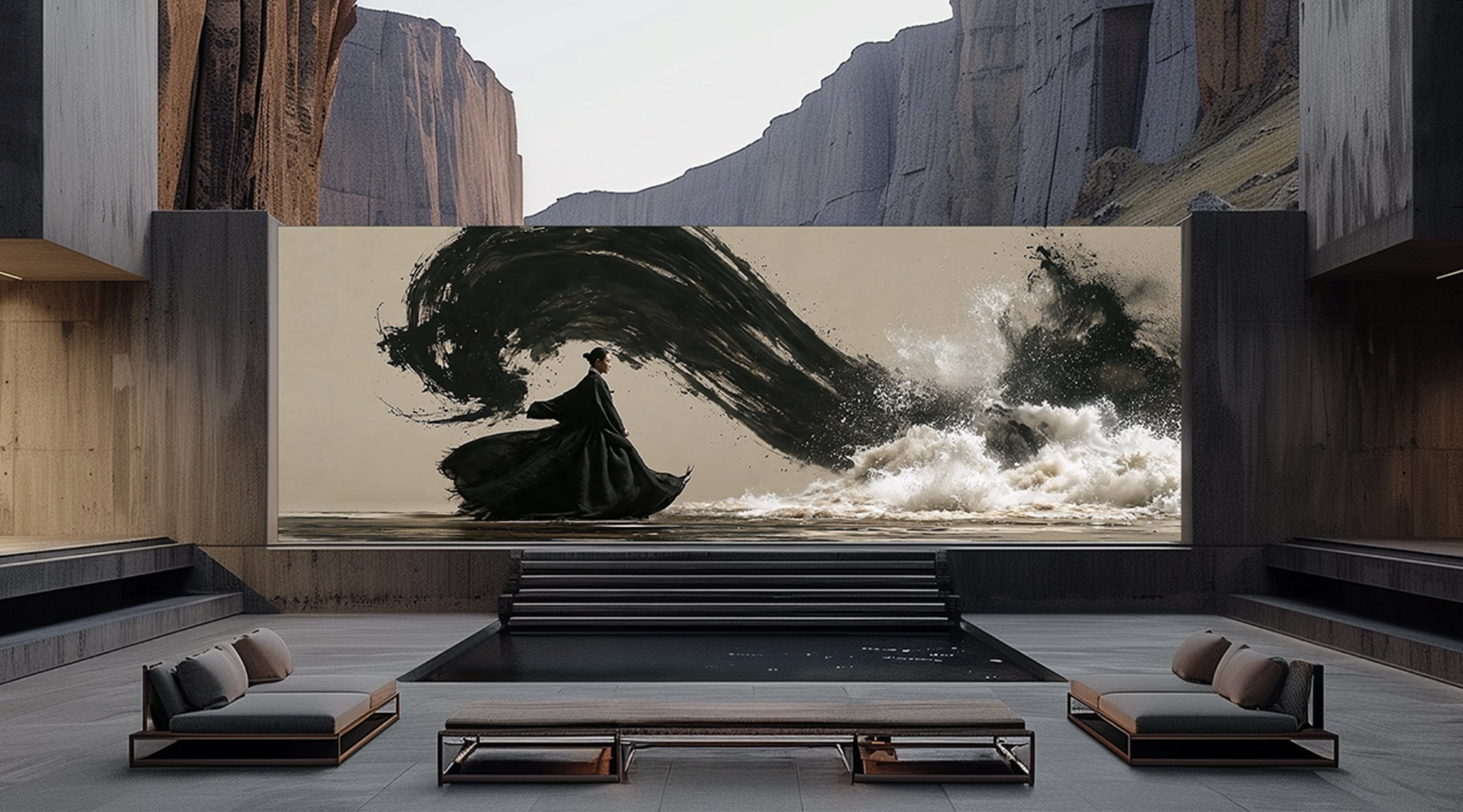
‘Where Ink Flows, The Mind Remains’ by Deajin.creates
Q1. Please briefly introduce yourself
A1. Hello. I am Daejin Kim, and I have been working in the editorial and graphic design fields for about 25 years. I have extensive design experience across creative agencies and fashion brands. Currently, I work in the railway and mobility sector, directing vehicle catalogues, promotional materials, photography and image art direction, and print production. I have contributed to visual projects for major rail vehicles including KTX-Eum, ITX-Maeum, and the Wirye Tram, while concurrently pursuing my creative practice with AI under the name daejin.creates.
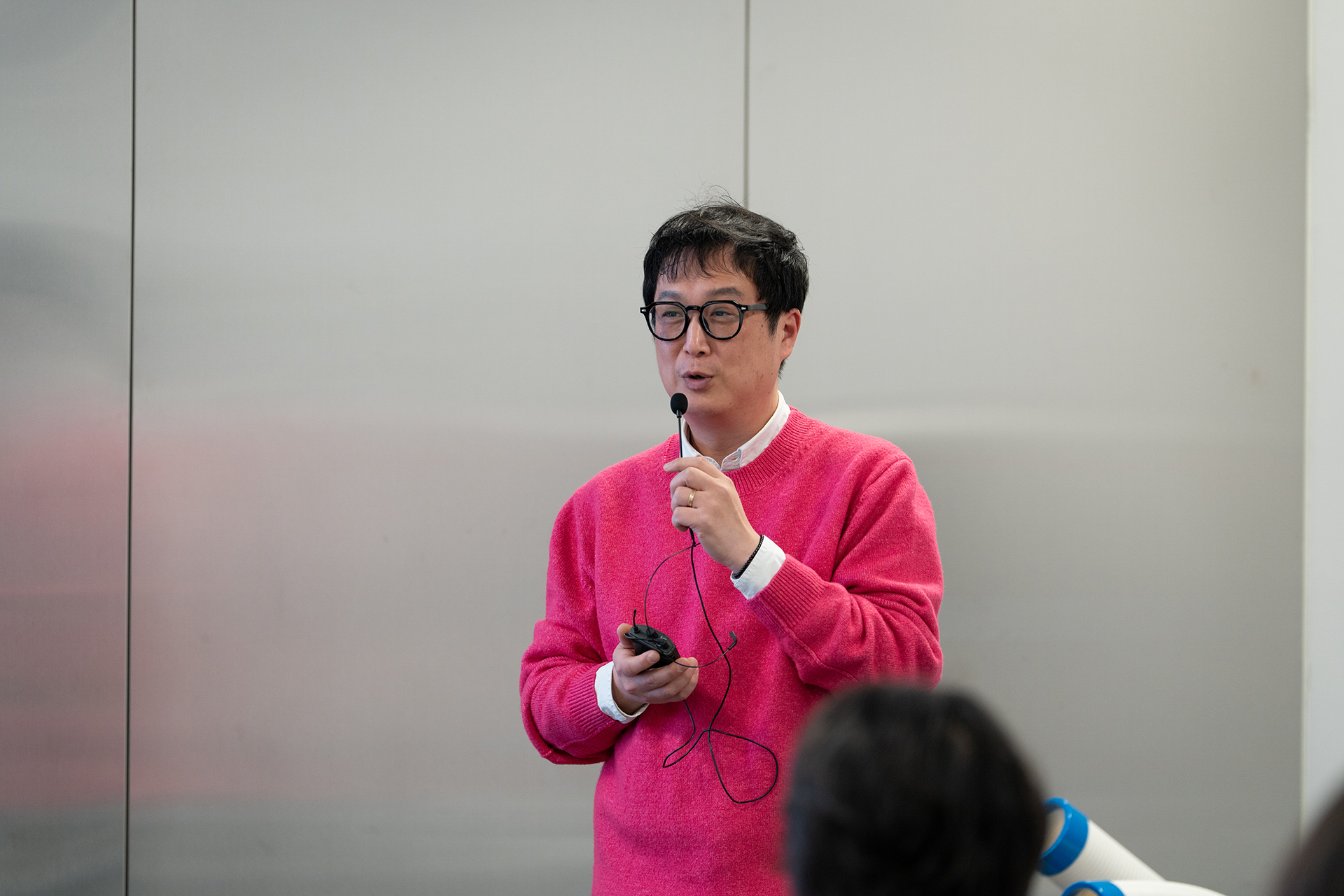
Photo by. Deajin Kim
Drawing upon decades of design practice centered on color, form, and composition, my current focus is on giving visual form to emotions, memories, psychological landscapes, and traditional Korean aesthetics.
Q2. What inspired you to become a media artist?
A2. Working in design for a long time naturally fostered my curiosity about emerging image-making methods, which led me to AI image-generation technologies. I subsequently discovered the Korea AI Creator Association, began participating in its activities, and naturally expanded my horizons by engaging with diverse AI creators. Because of my design background, crafting atmosphere, palette, shape, and balance within a single still image came naturally, yet AI introduced an exhilarating freedom: the ability to visualize mental scenes far more fluidly than ever before. It began with still frames, but soon prompted natural questions: “What happens when this image begins to move?” “How would this scene feel if unfolded across a massive screen or an immersive physical environment?”
These questions led me to expand into moving visuals, media art, concert staging visuals, and large-scale LED installations. Rather than a departure into a completely separate discipline, media art feels like an organic spatial and temporal extension of my 25 years in visual design—moving from static images to video, and ultimately into architectural space.
Q3. Where do you primarily draw inspiration for your work?
A3. I often draw inspiration directly from the emotions or psychological states I experience at a given moment. I examine how I currently feel, and sometimes I even work with emotion cards. Observing a single sentiment or word, I imagine what hue, silhouette, or physical materiality it might possess, frequently juxtaposing opposing concepts to create intentional friction.
For instance, I clash contrasting states within a single visual frame: stillness and anxiety, beauty and decay, strength and vulnerability, control and liberation, motion and rest. While seemingly incompatible, stillness is felt more profoundly against anxiety, liberation gains force against constraint, and beauty leaves a more striking impression when confronted with decay or imperfection. It is precisely within this contrast that emotional clarity emerges. I believe the coexistence of opposing feelings lends layered depth, imprinting itself longer in the viewer's memory. Uncovering unforeseen atmospheres throughout that tension is deeply fascinating
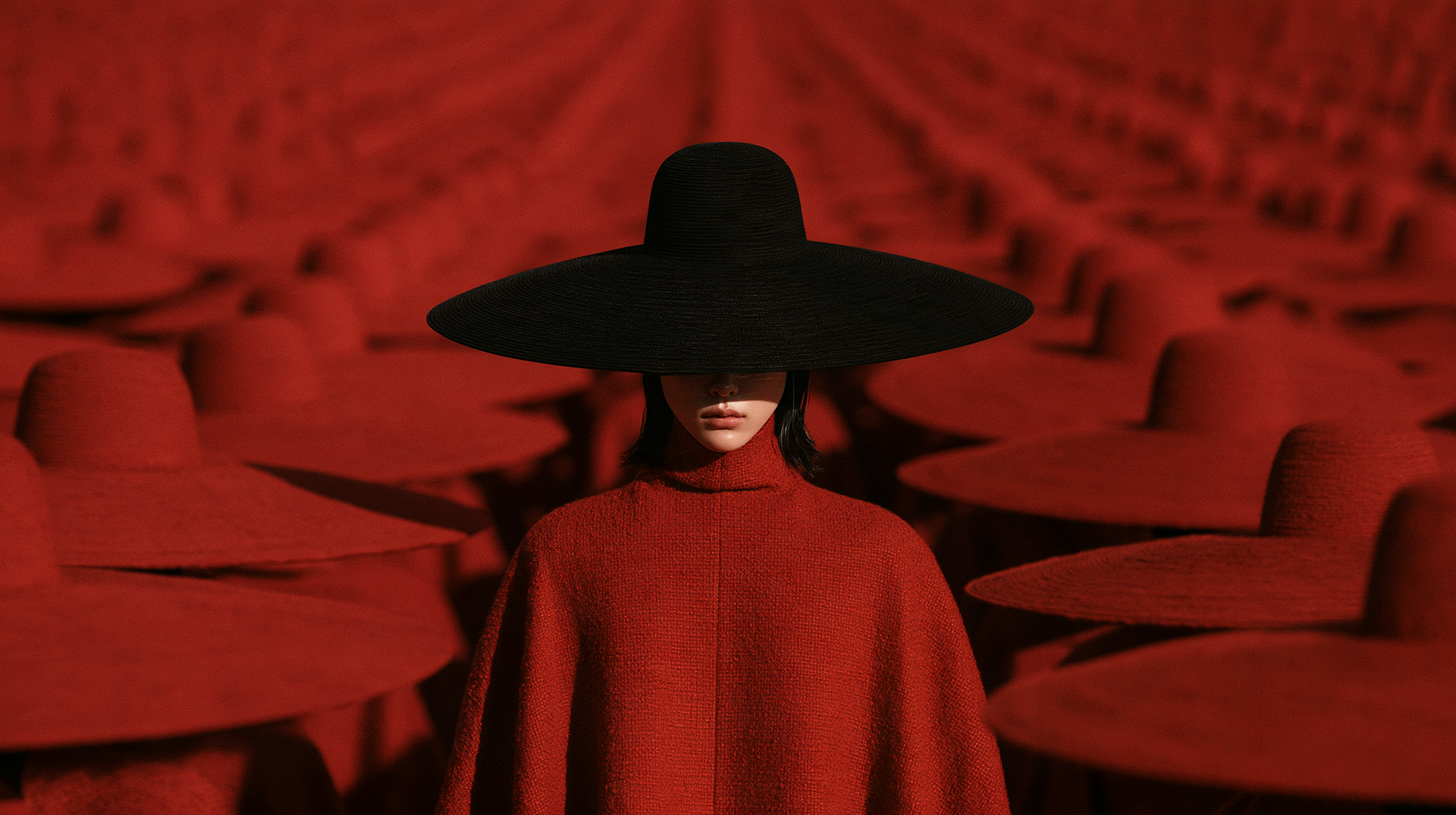
‘Repeating Indentica’ artwork by daejin.creates
Q4. Do you have role models, or specific artists and artworks that leave a strong impression?
A4. While there are many creators and masterworks I admire, looking excessively at others’ work risks unconsciously absorbing their aesthetic tropes. I strive to originate ideas from my own internal thoughts and reflections. Instead of specific contemporary artists, I often turn to ancient philosophical literature and classics, such as Han Feizi, for conceptual seeds. Classic literature encapsulates fundamental human realities that remain unaltered across centuries—desire, interpersonal dynamics, choice, power, and conflict. Reading these texts reveals touchpoints that mirror our contemporary condition as well as my personal experiences, which in turn ignite new imagery and emotional resonance.
Rather than imitating someone else's stylistic signature, I am much more drawn to digesting what I read, feel, and experience, translating those insights into idiosyncratic visuals and bespoke prompts. Given that AI has made replicating existing visual styles remarkably effortless, I believe it is far more critical—even if it takes time—to cultivate one’s own unique color palette, emotional tone, and visual language.
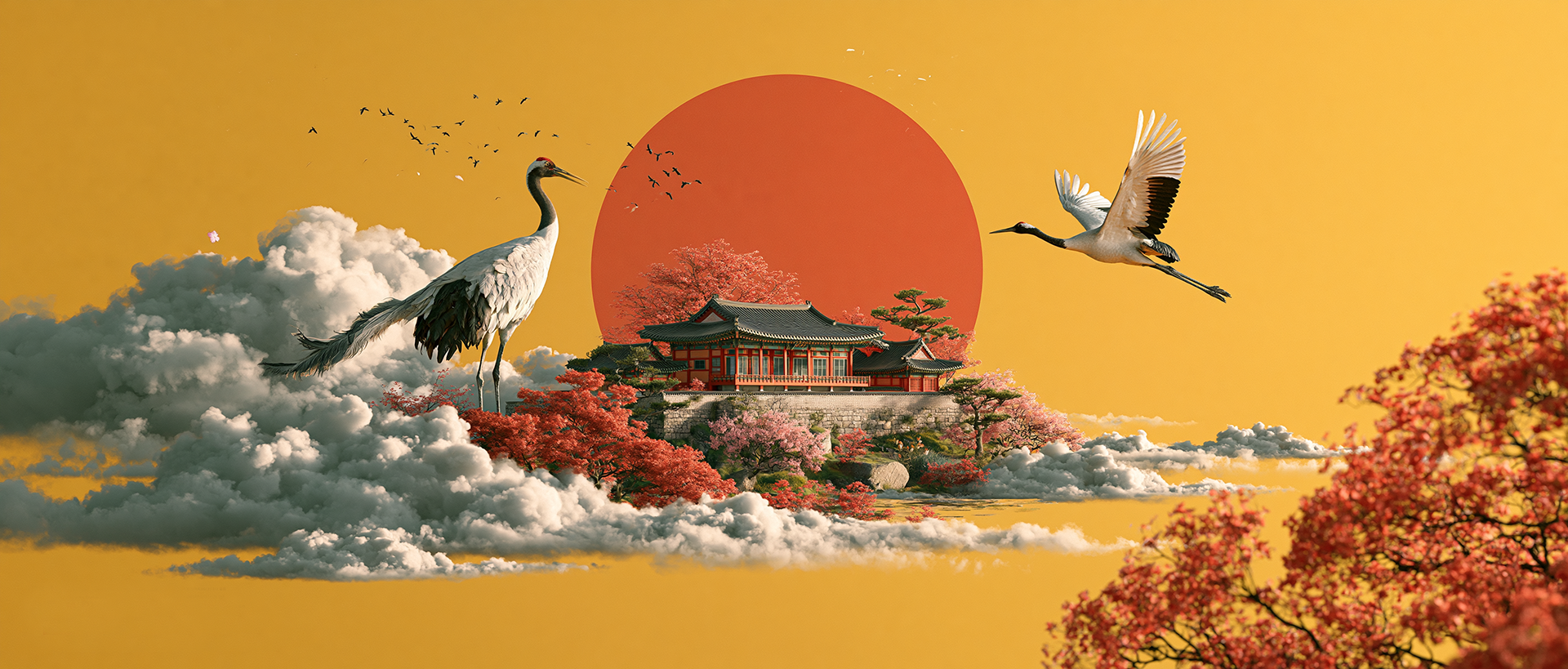
Artwork by Deajin.creates
Q5. Which tools or programs do you primarily utilize in your workflow?
A5. My image-making generally begins in Midjourney. I craft prompts based on intended moods, shapes, and feelings, generating iterative sets of images and selecting those closest to my creative intent.
However, I rarely use Midjourney outputs as finished pieces. I import the selected assets into Photoshop to refine composition, rebalance forms, eliminate unnecessary artifacts, and reconstruct essential elements down to the finest details. When necessary, I turn to Illustrator to draft and polish bespoke graphic elements and structural linework. Rather than taking the immediate output of an AI model as an end product, I cycle across multiple software environments to hone the piece. Ultimately, the question is not which program was employed, but the judgment behind choosing what to keep, what to alter, and where to bring the work to completion.
Q6. What core message or emotion do you wish to convey through your art?
A6. Rather than embedding a single definitive answer or a didactic message, I want to create a contemplative space where viewers can project their own emotions. Human memories and sentiments rarely exist in neat, distinct outlines. Some remain vivid, others fade into mist, and some shift into completely different manifestations over time. I am interested in expressing these elusive internal states through color, form, texture, movement, and negative space (여백, yeobaek).
For me, the creative process is not just about sharing my story with the world; it is an act of recognizing and bringing to consciousness emotions I had not yet fully understood myself. Consequently, recurring motifs of contradictory sensations appear throughout my pieces: quietude and unease, elegance and unfamiliarity, collapse and restoration. It does not matter whether viewers decipher my exact intentions. If a piece causes someone to pause, breathe, and recall an emotion or memory buried within themselves, that is more than enough.
Q7. Is there a particular piece among your works to which you feel the deepest attachment?
A7. Rather than a single standalone work, I feel the deepest attachment to my ongoing series combining traditional ink wash, wave motion, fluid water dynamics, and Korean motifs with psychological atmospheres.
Ink appears to be a simple monochrome medium, yet it possesses the fluid capacity to diffuse, scatter, gather, flow, and dissipate. I find this quality remarkably akin to the shifting nature of human emotions. Waves, similarly, appear repetitive, yet no single wave ever repeats the same morphology. Marrying ink and waves allows me to explore opposing states—stillness and motion, structure and turbulence, tension and release—within a single visual plane. Incorporating traditional Korean negative space, graceful calligraphic curves, and organic natural forms completes the subtle, contemplative atmosphere I cherish. Experiencing the gradual emergence of daejin.creates’ distinctive visual grammar across these layered works is what I value most.
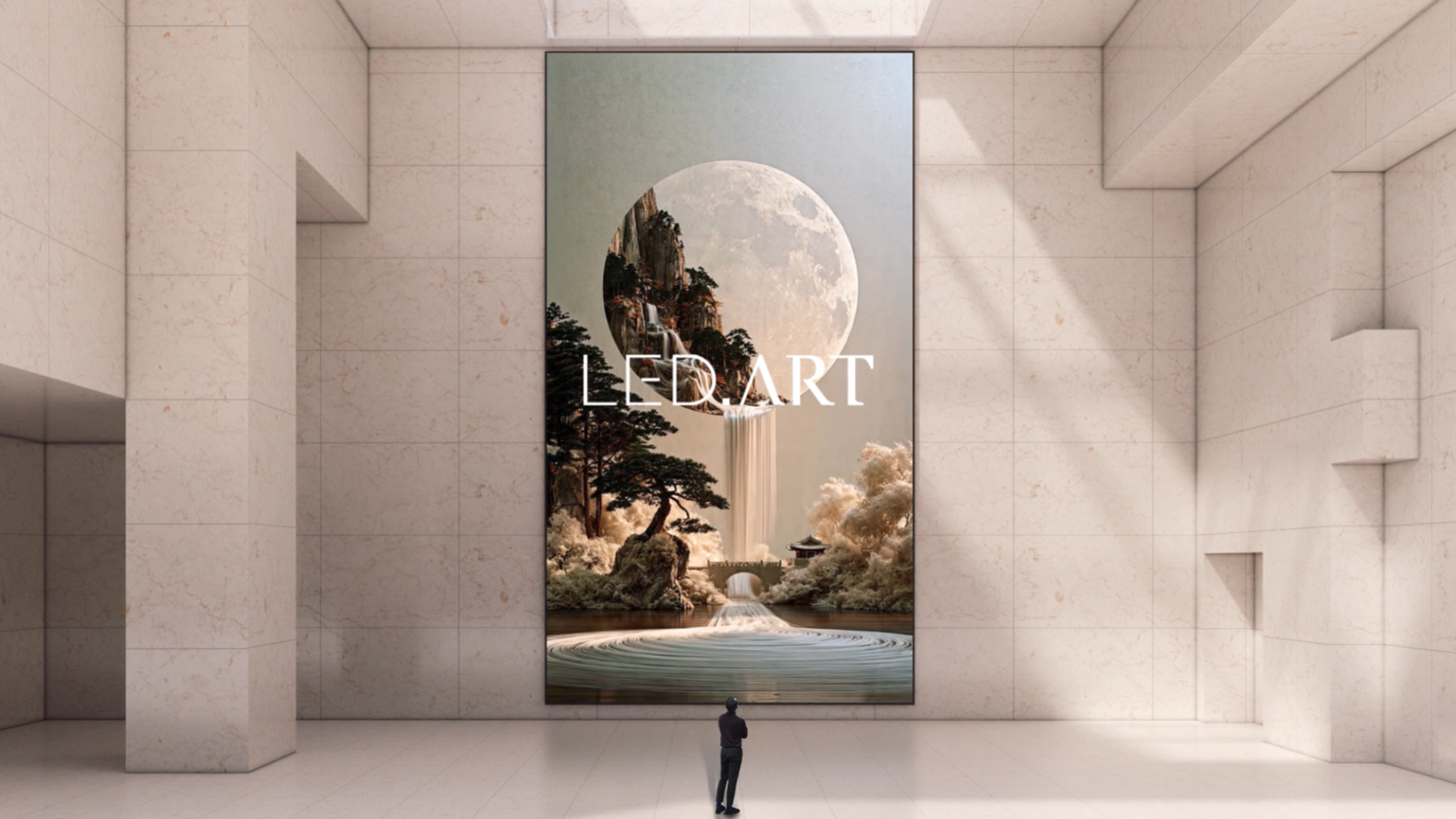
‘The River Beneath The Moon’ by Deajin.creates
Q8. What has been your greatest challenge as an artist, and how are you navigating it?
A8. The most profound challenge has been the transition from being a commercial designer for over two decades to stepping into the identity of an artist authoring personal work. Design invariably serves an external objective and client criteria; it delivers a clear message toward an intended outcome. Artistic creation, however, demands that you formulate your own questions and uncover your own answers.
Inevitably, the challenge was less about technical mastery and more about self-inquiry: “What do I truly love?” and “Why do I continue producing these specific images?” When making personal work, it is easy to become conflicted about whether you are creating out of genuine passion, seeking external validation, or simply chasing prevailing trends. Confronting these doubts led me to closely observe the recurring motifs and feelings in my pieces. Through this process, I have begun to understand not just my creative taste, but my inner vulnerabilities, anxieties, desires, and psychological tendencies.
The breathtaking pace of AI advancement has introduced another layer of contemplation. Generating high-quality images has become accessible to virtually anyone. As technical barriers drop, the question shifts decisively from “How well do you manipulate the tool?” to “Why are you creating this in the first place?” This naturally touches upon the ethics and essence of authorship. Replicating another artist’s style in AI is simple, and technical possibilities multiply daily, but I believe that what can be done and what ought to be done remain fundamentally distinct matters.
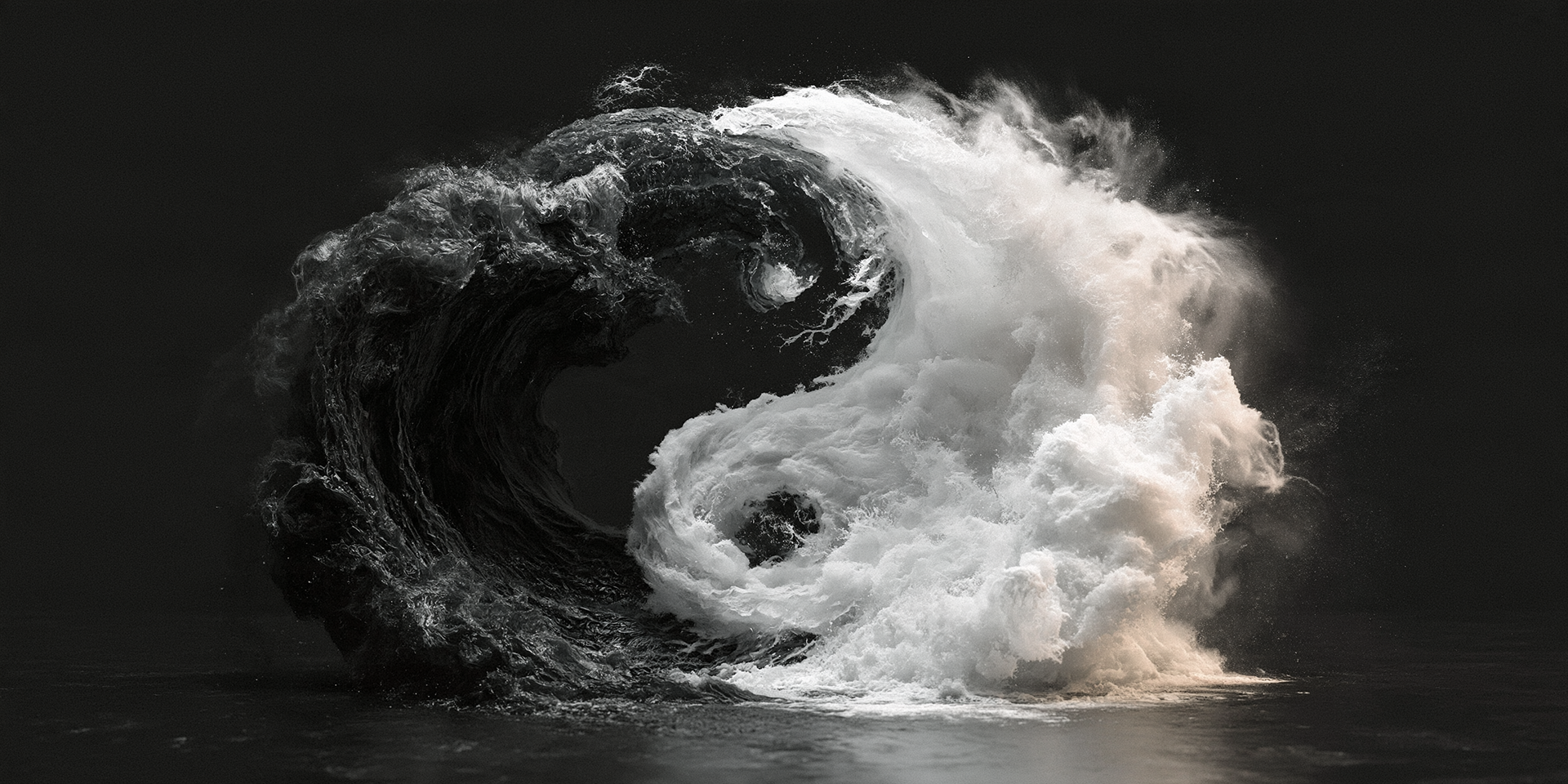
Artwork by Deajin.creates
I constantly ask myself: Where does my agency and genuine authorship lie? Am I merely mimicking another's visual path? Can I articulate why I chose this specific frame? Navigating this challenge is not merely about keeping pace with new technologies; it is a discipline of ongoing self-discovery and defining personal creative integrity. I do not believe this dilemma is ever fully conquered. Rather, by continually creating, discarding, choosing anew, and reflecting on recurring imagery, I am clarifying my compass. For me, articulating why an image was chosen matters far more than sheer volume of output.
Q9. Among your exhibitions, collaborations, and awards, which experiences stand out most?
A9. Watching personal experiments evolve over the past few years from screen renders into physical exhibitions, live concert arenas, and international platforms has been deeply memorable.
Participating in the creation of AI visual content for the NCT 127 concert was a decisive milestone. Seeing personal imagery and AI motion sequences scaled across massive arena LED walls, interwoven with music and live staging before global audiences, demonstrated firsthand how personal artwork can scale into world-class performance content.
Among exhibitions, participating in the 15th Korea-China-Japan International Artists Exhibition at the 2025 Qingdao International Art Festival (QIAF) stands out, alongside the Parasite v1 exhibition and Andy Warhol: The Birth of a Myth at Daegu Museeum. Since then, my work has steadily gained exposure across diverse global channels and platforms, and being recognized multiple times as an IIIIL.AI Featured Artist was an invaluable opportunity to engage with international AI creators and collectors. These moments confirmed that emotional resonance and visual atmosphere can transcend linguistic and cultural boundaries, fueling my desire to share my work globally through more expansive formats.
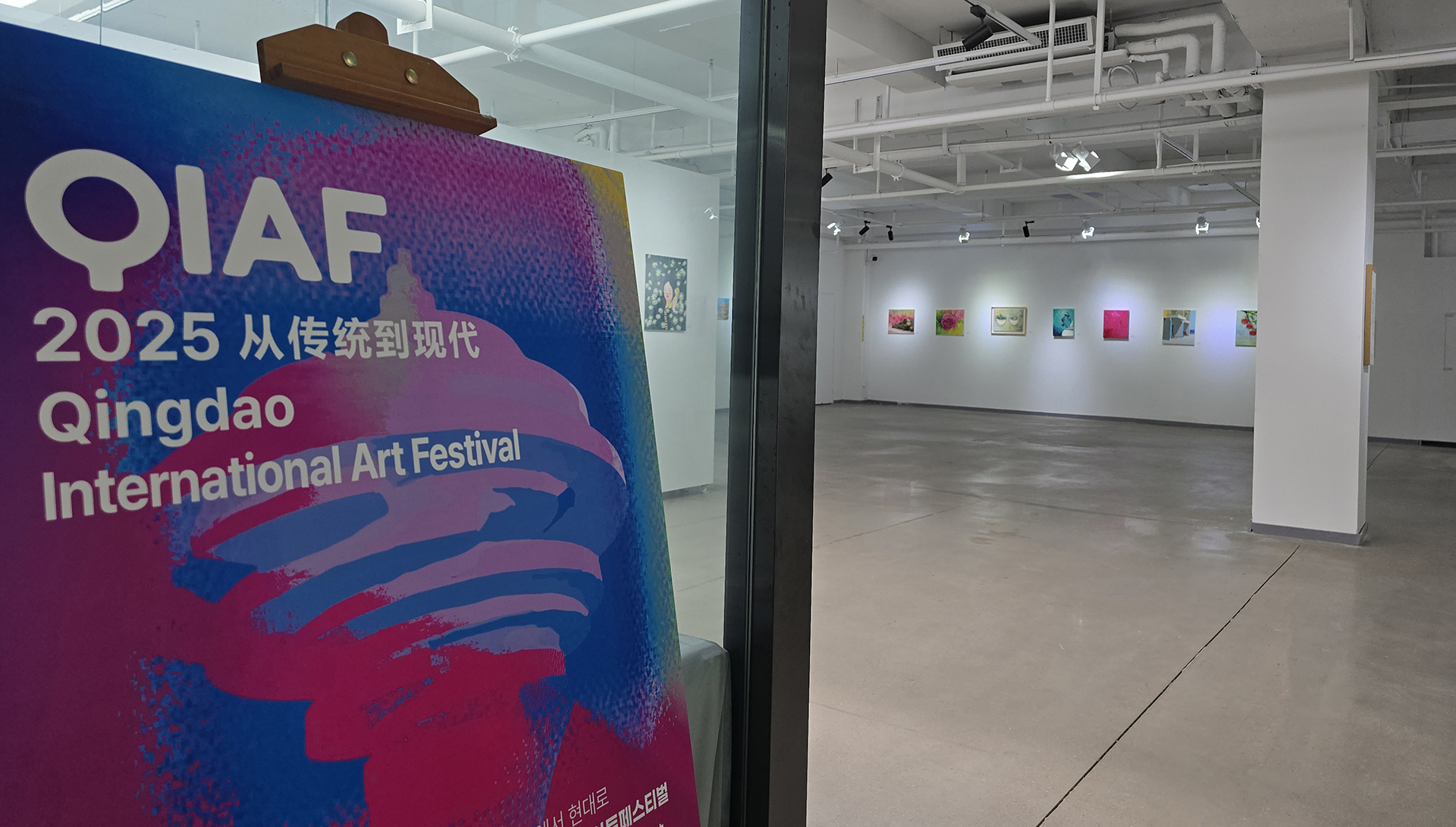
Qiaf 2025 Qingdao International Art Festival photo by Deajin Kim
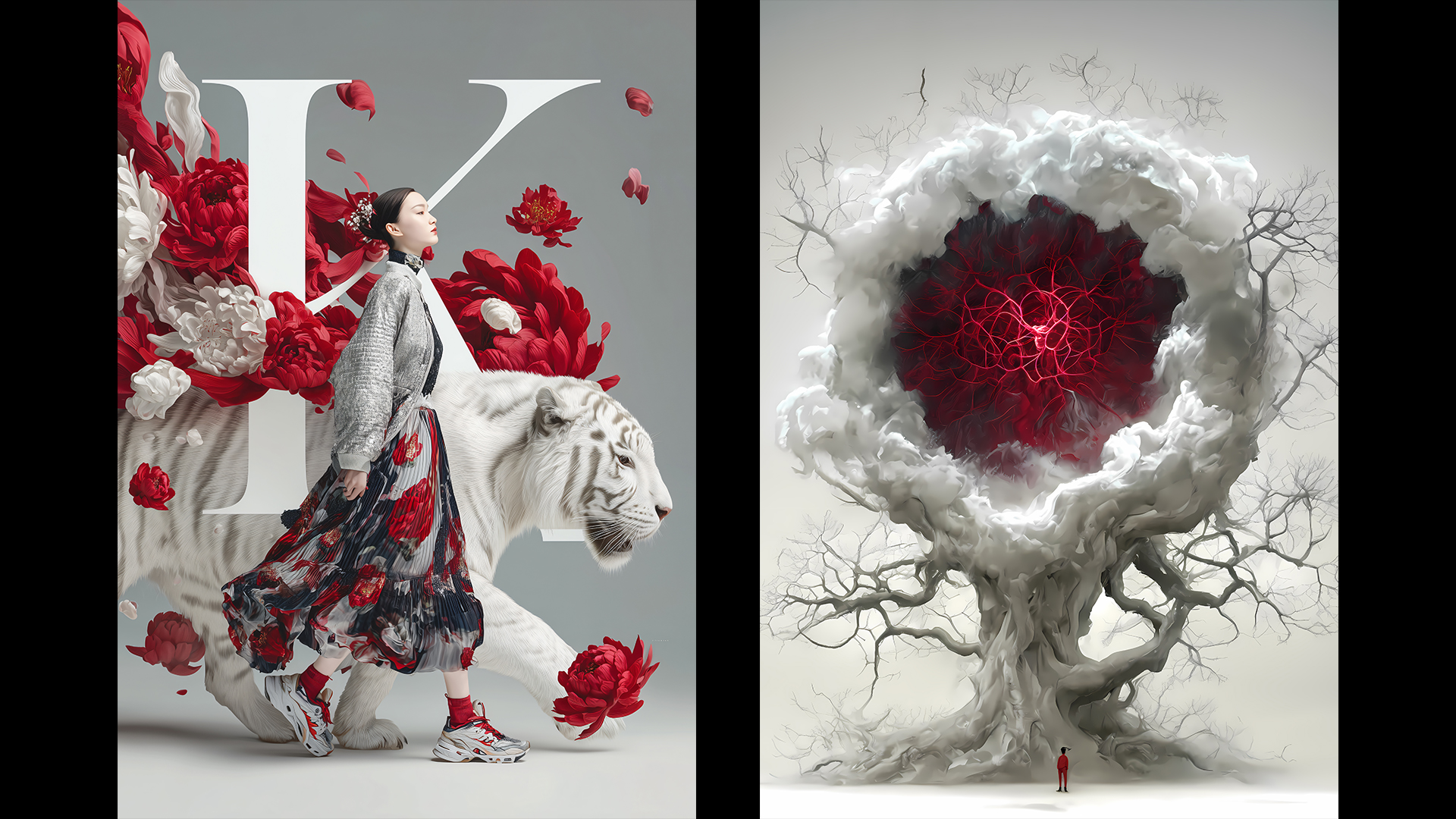
(Left) ‘Parasite v1’ exhibited at Daegu Museeum, artwork by daejin Kim
(Right) ‘Shall I Show You the Core of Emotion? ‘ from Andy Warhol: The Birth of a Myth, artwork by daejin Kim
Awards such as the Excellence Award at the 3rd Korea NFT Digital Art Competition, the Encouragement Award at the Seoul Metro Photography & Calligraphy Contest, and the Encouragement Award at the APEC 2025 KOREA Gyeongju Design Contest have been very encouraging. Yet beyond the accolades themselves, the true reward is seeing personal explorations steadily cross over into exhibitions, concerts, international platforms, and architectural environments.
Q10. Are there any changes or interesting trends in the digital art scene that you are currently paying attention to?
A10. The most prominent shift is that AI is becoming effortlessly accessible. As tools evolve, we are approaching an era where anyone can generate striking visuals and motion assets with ease, multiplying individual production capacity exponentially.
Yet ironically, this abundance makes certain qualities increasingly rare and precious: Judgment, Selection, and Direction. Even if AI generates hundreds or thousands of viable options, deciding what to choose and how to direct the narrative remains the exclusive domain of human discernment. Cultivating an eye that knows what to create, developing an intuition for what aligns with one's voice, and establishing the discipline to discard will matter more than ever.
Going forward, mastering specific software prompts will be secondary to understanding fundamental design principles, visual semiotics, human psychology, cultural philosophy, and one’s own internal criteria of evaluation. As technical execution becomes commoditized, human experience, taste, and intentional selection become paramount. Rather than running breathlessly after every model release, my focus remains firmly on sharpening the eye that decides what to build with these tools.
Q11. What do you hope for from LED.ART, or what role do you expect it to play?
A11. Digital creators have ample opportunities to present work online, yet opportunities to experience those works embodied in physical, spatial dimensions remain comparatively scarce. In that regard, I hope LED.ART evolves beyond a marketplace platform to serve as a vital bridge connecting distinguished digital artworks with architectural spaces. When digital art meets diverse real-world settings—whether hotels, corporate headquarters, cultural venues, or high-end retail spaces—it encounters fresh audiences, while allowing artists to witness how their creations interact with unpredictable environments. That interaction is itself a powerful creative catalyst.
Additionally, I hope the platform continues to discover and illuminate pioneering creators exploring unconventional methods, alongside established names. Collaborative collections with creative associations, curated themed showcases, and artist-discovery initiatives would be extraordinarily meaningful steps.
Q12. Could you share your future plans or artistic goals?
A12. My overarching goal is to distill my accumulated design background, Korean aesthetic sensibility, psychological curiosity, and AI image/motion experiments into a single, unmistakably coherent visual language. Creating Korean-inspired visuals does not mean merely replicating traditional motifs. I want to take the enduring sensations embedded within Korean heritage—the dispersion of ink, generous negative space (yeobaek), calligraphic contouring, water, and mountains—and weave them together with contemporary sensibilities and psychological depths.
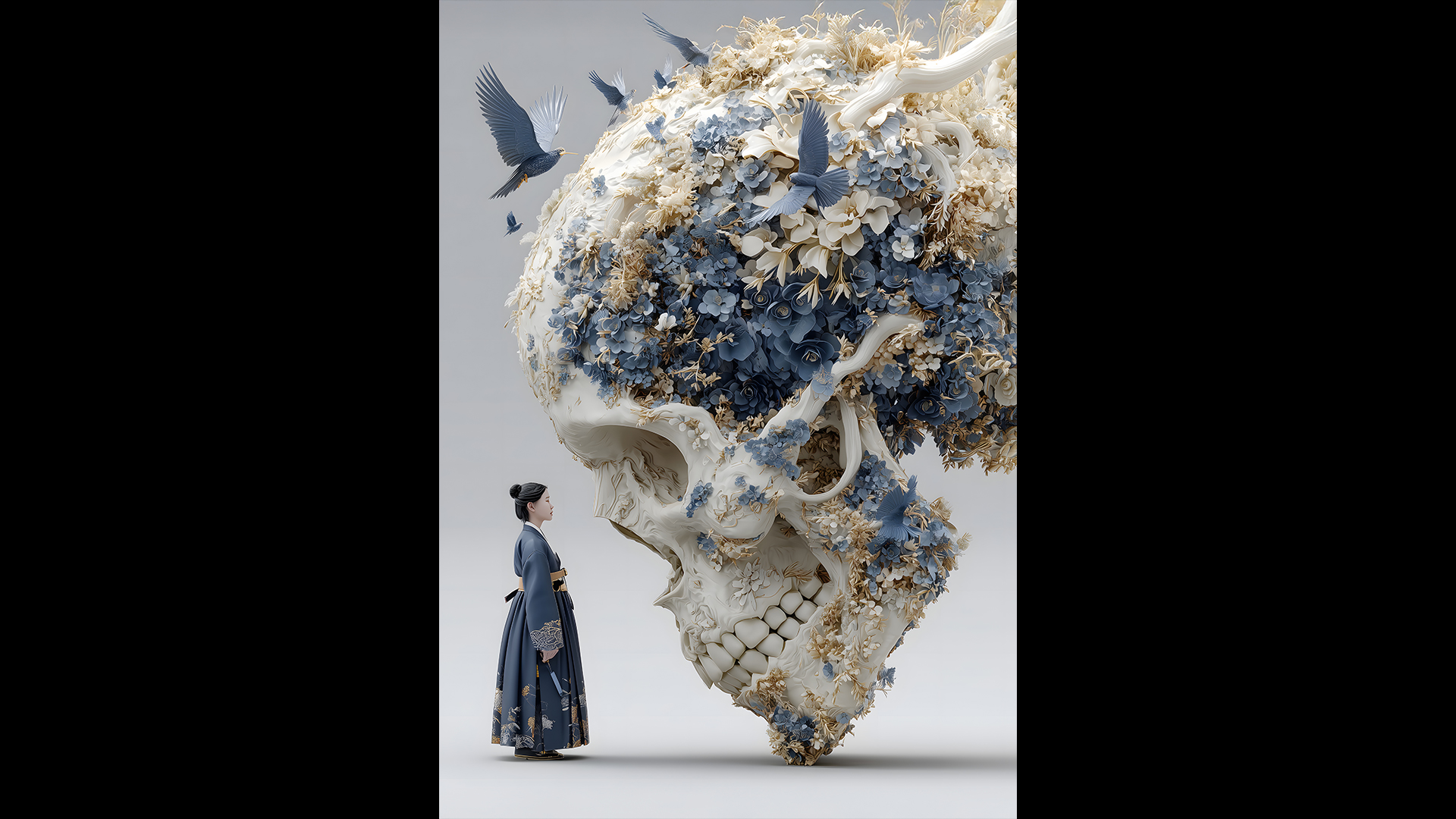
‘Parasite v1’ exhibited at Daegu Museeum, artwork by Daejin Kim
Another key interest is exploring how imagery mutates when crossing disciplinary boundaries. Beyond personal gallery shows, I look forward to ongoing cross-pollinations with live stage direction, commercial brand narratives, spatial installations, and architectural media facades, connecting with audiences both in Korea and internationally.
Ultimately, I want to create work where the emotion and the image speak before the AI technology is ever noticed. Rather than having viewers ask, “Which AI tool generated this?” I hope they reflect: “This image lingers in my mind strangely long,” or “I felt something profound standing before this piece.” As my body of work grows, my enduring ambition is to craft a signature visual language where audiences immediately recognize the atmosphere and soul of daejin.creates without ever needing to read the artist’s name.
#media artist #media art #digital content #digital art #digiral screen #art video #curation #3D video #media art licensing service #premium space #art trend #nature media art #space experience #interior #digital canvas #immersive art








[Artist Interview]
Resonating Emotion Beyond Technology in the Age of AI:
Artist KimDaejin
by LED.ART EDITORIAL
Have you ever encountered the deep emotions seeping through the heavy spread of ink and the restless surge of waves? Daejin Kim (daejin.creates), an artist with a robust 25-year foundation spanning editorial design, rail vehicle identity systems like KTX, and large-scale stage visuals, has recently taken up AI as his new artistic brush. In translating the intangible imagery of his mind onto and beyond the screen, his work weaves traditional Korean aesthetics—such as ink flow and crashing waves—with conflicting inner states: stillness and anxiety, restraint and liberation. More than fleeting technical novelty, he aims to leave behind images that linger deeply in the viewer's consciousness. Here is the sincere story behind artist Daejin Kim’s visual journey.
‘Where Ink Flows, The Mind Remains’ by Deajin.creates
Q1. Please briefly introduce yourself
A1. Hello. I am Daejin Kim, and I have been working in the editorial and graphic design fields for about 25 years. I have extensive design experience across creative agencies and fashion brands. Currently, I work in the railway and mobility sector, directing vehicle catalogues, promotional materials, photography and image art direction, and print production. I have contributed to visual projects for major rail vehicles including KTX-Eum, ITX-Maeum, and the Wirye Tram, while concurrently pursuing my creative practice with AI under the name daejin.creates.
Photo by. Deajin Kim
Drawing upon decades of design practice centered on color, form, and composition, my current focus is on giving visual form to emotions, memories, psychological landscapes, and traditional Korean aesthetics.
Q2. What inspired you to become a media artist?
A2. Working in design for a long time naturally fostered my curiosity about emerging image-making methods, which led me to AI image-generation technologies. I subsequently discovered the Korea AI Creator Association, began participating in its activities, and naturally expanded my horizons by engaging with diverse AI creators. Because of my design background, crafting atmosphere, palette, shape, and balance within a single still image came naturally, yet AI introduced an exhilarating freedom: the ability to visualize mental scenes far more fluidly than ever before. It began with still frames, but soon prompted natural questions: “What happens when this image begins to move?” “How would this scene feel if unfolded across a massive screen or an immersive physical environment?”
These questions led me to expand into moving visuals, media art, concert staging visuals, and large-scale LED installations. Rather than a departure into a completely separate discipline, media art feels like an organic spatial and temporal extension of my 25 years in visual design—moving from static images to video, and ultimately into architectural space.
Q3. Where do you primarily draw inspiration for your work?
A3. I often draw inspiration directly from the emotions or psychological states I experience at a given moment. I examine how I currently feel, and sometimes I even work with emotion cards. Observing a single sentiment or word, I imagine what hue, silhouette, or physical materiality it might possess, frequently juxtaposing opposing concepts to create intentional friction.
For instance, I clash contrasting states within a single visual frame: stillness and anxiety, beauty and decay, strength and vulnerability, control and liberation, motion and rest. While seemingly incompatible, stillness is felt more profoundly against anxiety, liberation gains force against constraint, and beauty leaves a more striking impression when confronted with decay or imperfection. It is precisely within this contrast that emotional clarity emerges. I believe the coexistence of opposing feelings lends layered depth, imprinting itself longer in the viewer's memory. Uncovering unforeseen atmospheres throughout that tension is deeply fascinating
‘Repeating Indentica’ artwork by daejin.creates
Q4. Do you have role models, or specific artists and artworks that leave a strong impression?
A4. While there are many creators and masterworks I admire, looking excessively at others’ work risks unconsciously absorbing their aesthetic tropes. I strive to originate ideas from my own internal thoughts and reflections. Instead of specific contemporary artists, I often turn to ancient philosophical literature and classics, such as Han Feizi, for conceptual seeds. Classic literature encapsulates fundamental human realities that remain unaltered across centuries—desire, interpersonal dynamics, choice, power, and conflict. Reading these texts reveals touchpoints that mirror our contemporary condition as well as my personal experiences, which in turn ignite new imagery and emotional resonance.
Rather than imitating someone else's stylistic signature, I am much more drawn to digesting what I read, feel, and experience, translating those insights into idiosyncratic visuals and bespoke prompts. Given that AI has made replicating existing visual styles remarkably effortless, I believe it is far more critical—even if it takes time—to cultivate one’s own unique color palette, emotional tone, and visual language.
Artwork by Deajin.creates
Q5. Which tools or programs do you primarily utilize in your workflow?
A5. My image-making generally begins in Midjourney. I craft prompts based on intended moods, shapes, and feelings, generating iterative sets of images and selecting those closest to my creative intent.
However, I rarely use Midjourney outputs as finished pieces. I import the selected assets into Photoshop to refine composition, rebalance forms, eliminate unnecessary artifacts, and reconstruct essential elements down to the finest details. When necessary, I turn to Illustrator to draft and polish bespoke graphic elements and structural linework. Rather than taking the immediate output of an AI model as an end product, I cycle across multiple software environments to hone the piece. Ultimately, the question is not which program was employed, but the judgment behind choosing what to keep, what to alter, and where to bring the work to completion.
Q6. What core message or emotion do you wish to convey through your art?
A6. Rather than embedding a single definitive answer or a didactic message, I want to create a contemplative space where viewers can project their own emotions. Human memories and sentiments rarely exist in neat, distinct outlines. Some remain vivid, others fade into mist, and some shift into completely different manifestations over time. I am interested in expressing these elusive internal states through color, form, texture, movement, and negative space (여백, yeobaek).
For me, the creative process is not just about sharing my story with the world; it is an act of recognizing and bringing to consciousness emotions I had not yet fully understood myself. Consequently, recurring motifs of contradictory sensations appear throughout my pieces: quietude and unease, elegance and unfamiliarity, collapse and restoration. It does not matter whether viewers decipher my exact intentions. If a piece causes someone to pause, breathe, and recall an emotion or memory buried within themselves, that is more than enough.
Q7. Is there a particular piece among your works to which you feel the deepest attachment?
A7. Rather than a single standalone work, I feel the deepest attachment to my ongoing series combining traditional ink wash, wave motion, fluid water dynamics, and Korean motifs with psychological atmospheres.
Ink appears to be a simple monochrome medium, yet it possesses the fluid capacity to diffuse, scatter, gather, flow, and dissipate. I find this quality remarkably akin to the shifting nature of human emotions. Waves, similarly, appear repetitive, yet no single wave ever repeats the same morphology. Marrying ink and waves allows me to explore opposing states—stillness and motion, structure and turbulence, tension and release—within a single visual plane. Incorporating traditional Korean negative space, graceful calligraphic curves, and organic natural forms completes the subtle, contemplative atmosphere I cherish. Experiencing the gradual emergence of daejin.creates’ distinctive visual grammar across these layered works is what I value most.
‘The River Beneath The Moon’ by Deajin.creates
Q8. What has been your greatest challenge as an artist, and how are you navigating it?
A8. The most profound challenge has been the transition from being a commercial designer for over two decades to stepping into the identity of an artist authoring personal work. Design invariably serves an external objective and client criteria; it delivers a clear message toward an intended outcome. Artistic creation, however, demands that you formulate your own questions and uncover your own answers.
Inevitably, the challenge was less about technical mastery and more about self-inquiry: “What do I truly love?” and “Why do I continue producing these specific images?” When making personal work, it is easy to become conflicted about whether you are creating out of genuine passion, seeking external validation, or simply chasing prevailing trends. Confronting these doubts led me to closely observe the recurring motifs and feelings in my pieces. Through this process, I have begun to understand not just my creative taste, but my inner vulnerabilities, anxieties, desires, and psychological tendencies.
The breathtaking pace of AI advancement has introduced another layer of contemplation. Generating high-quality images has become accessible to virtually anyone. As technical barriers drop, the question shifts decisively from “How well do you manipulate the tool?” to “Why are you creating this in the first place?” This naturally touches upon the ethics and essence of authorship. Replicating another artist’s style in AI is simple, and technical possibilities multiply daily, but I believe that what can be done and what ought to be done remain fundamentally distinct matters.
Artwork by Deajin.creates
I constantly ask myself: Where does my agency and genuine authorship lie? Am I merely mimicking another's visual path? Can I articulate why I chose this specific frame? Navigating this challenge is not merely about keeping pace with new technologies; it is a discipline of ongoing self-discovery and defining personal creative integrity. I do not believe this dilemma is ever fully conquered. Rather, by continually creating, discarding, choosing anew, and reflecting on recurring imagery, I am clarifying my compass. For me, articulating why an image was chosen matters far more than sheer volume of output.
Q9. Among your exhibitions, collaborations, and awards, which experiences stand out most?
A9. Watching personal experiments evolve over the past few years from screen renders into physical exhibitions, live concert arenas, and international platforms has been deeply memorable.
Participating in the creation of AI visual content for the NCT 127 concert was a decisive milestone. Seeing personal imagery and AI motion sequences scaled across massive arena LED walls, interwoven with music and live staging before global audiences, demonstrated firsthand how personal artwork can scale into world-class performance content.
Among exhibitions, participating in the 15th Korea-China-Japan International Artists Exhibition at the 2025 Qingdao International Art Festival (QIAF) stands out, alongside the Parasite v1 exhibition and Andy Warhol: The Birth of a Myth at Daegu Museeum. Since then, my work has steadily gained exposure across diverse global channels and platforms, and being recognized multiple times as an IIIIL.AI Featured Artist was an invaluable opportunity to engage with international AI creators and collectors. These moments confirmed that emotional resonance and visual atmosphere can transcend linguistic and cultural boundaries, fueling my desire to share my work globally through more expansive formats.
Qiaf 2025 Qingdao International Art Festival photo by Deajin Kim
(Left) ‘Parasite v1’ exhibited at Daegu Museeum, artwork by daejin Kim
(Right) ‘Shall I Show You the Core of Emotion? ‘ from Andy Warhol: The Birth of a Myth, artwork by daejin Kim
Awards such as the Excellence Award at the 3rd Korea NFT Digital Art Competition, the Encouragement Award at the Seoul Metro Photography & Calligraphy Contest, and the Encouragement Award at the APEC 2025 KOREA Gyeongju Design Contest have been very encouraging. Yet beyond the accolades themselves, the true reward is seeing personal explorations steadily cross over into exhibitions, concerts, international platforms, and architectural environments.
Q10. Are there any changes or interesting trends in the digital art scene that you are currently paying attention to?
A10. The most prominent shift is that AI is becoming effortlessly accessible. As tools evolve, we are approaching an era where anyone can generate striking visuals and motion assets with ease, multiplying individual production capacity exponentially.
Yet ironically, this abundance makes certain qualities increasingly rare and precious: Judgment, Selection, and Direction. Even if AI generates hundreds or thousands of viable options, deciding what to choose and how to direct the narrative remains the exclusive domain of human discernment. Cultivating an eye that knows what to create, developing an intuition for what aligns with one's voice, and establishing the discipline to discard will matter more than ever.
Going forward, mastering specific software prompts will be secondary to understanding fundamental design principles, visual semiotics, human psychology, cultural philosophy, and one’s own internal criteria of evaluation. As technical execution becomes commoditized, human experience, taste, and intentional selection become paramount. Rather than running breathlessly after every model release, my focus remains firmly on sharpening the eye that decides what to build with these tools.
Q11. What do you hope for from LED.ART, or what role do you expect it to play?
A11. Digital creators have ample opportunities to present work online, yet opportunities to experience those works embodied in physical, spatial dimensions remain comparatively scarce. In that regard, I hope LED.ART evolves beyond a marketplace platform to serve as a vital bridge connecting distinguished digital artworks with architectural spaces. When digital art meets diverse real-world settings—whether hotels, corporate headquarters, cultural venues, or high-end retail spaces—it encounters fresh audiences, while allowing artists to witness how their creations interact with unpredictable environments. That interaction is itself a powerful creative catalyst.
Additionally, I hope the platform continues to discover and illuminate pioneering creators exploring unconventional methods, alongside established names. Collaborative collections with creative associations, curated themed showcases, and artist-discovery initiatives would be extraordinarily meaningful steps.
Q12. Could you share your future plans or artistic goals?
A12. My overarching goal is to distill my accumulated design background, Korean aesthetic sensibility, psychological curiosity, and AI image/motion experiments into a single, unmistakably coherent visual language. Creating Korean-inspired visuals does not mean merely replicating traditional motifs. I want to take the enduring sensations embedded within Korean heritage—the dispersion of ink, generous negative space (yeobaek), calligraphic contouring, water, and mountains—and weave them together with contemporary sensibilities and psychological depths.
‘Parasite v1’ exhibited at Daegu Museeum, artwork by Daejin Kim
Another key interest is exploring how imagery mutates when crossing disciplinary boundaries. Beyond personal gallery shows, I look forward to ongoing cross-pollinations with live stage direction, commercial brand narratives, spatial installations, and architectural media facades, connecting with audiences both in Korea and internationally.
Ultimately, I want to create work where the emotion and the image speak before the AI technology is ever noticed. Rather than having viewers ask, “Which AI tool generated this?” I hope they reflect: “This image lingers in my mind strangely long,” or “I felt something profound standing before this piece.” As my body of work grows, my enduring ambition is to craft a signature visual language where audiences immediately recognize the atmosphere and soul of daejin.creates without ever needing to read the artist’s name.
#media artist #media art #digital content #digital art #digiral screen #art video #curation #3D video #media art licensing service #premium space #art trend #nature media art #space experience #interior #digital canvas #immersive art